
Why Nota AI Was the Only Korean Company on the Panel at NVIDIA's APAC Partner Day: The Final Piece of Physical AI

Jaehoon Lee
Technical Content Manager, Nota AI
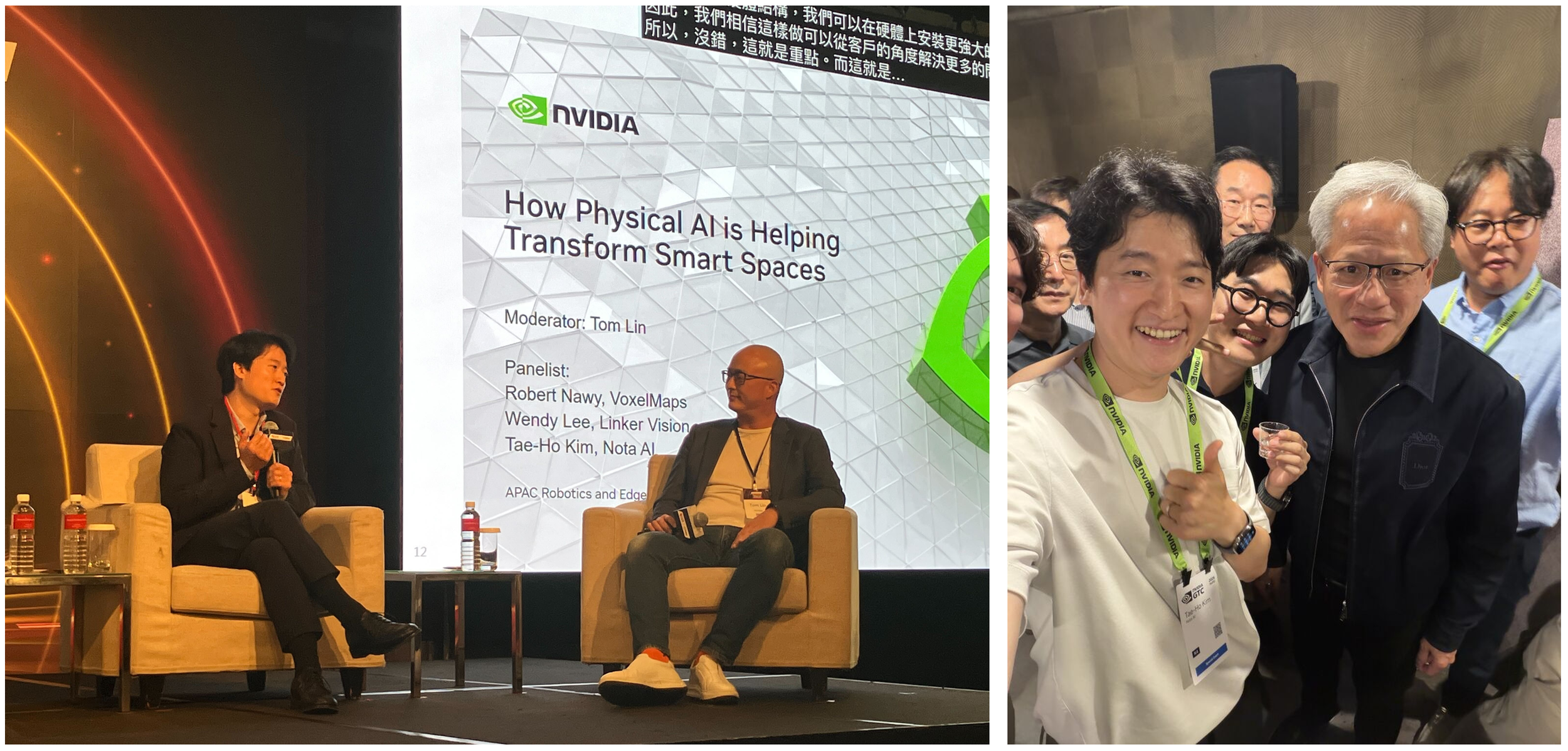
Figure 1: Tae-Ho Kim, Co-Founder & CTO of Nota AI, at NVIDIA's APAC Robotics and Edge AI Partner Day and the Korea Partner Night
Computex 2026 in Taiwan brought together the innovative technologies of tech companies from around the world. Among its many sessions, the one where the future vision of next-generation AI was debated most intensely was, without question, NVIDIA's APAC Robotics and Edge AI Partner Day. At this gathering, where leading hardware manufacturers and frontier AI companies from each country competed fiercely for technological leadership, Nota AI was the only Korean company to earn a seat on the panel.
There, Tae-Ho Kim, CTO of Nota AI, engaged in in-depth discussions with global companies on the themes of Physical AI and edge optimization. Behind the fact that Nota AI, a company specializing in model optimization, could stand shoulder to shoulder with formidable hardware and robotics players lies a shared industry concern hidden beneath the dazzle of the technology.
NVIDIA's Blueprint: Physical AI Enters the Real World
The biggest topic in the industry today is, without doubt, "Physical AI." While AI agents drive the automation of the software domain (coding, office work, and the like), Physical AI signals a paradigm shift in which AI moves beyond chatbots and screens to step directly into the real physical world of factories, roads, cities, and robots, where it perceives and acts.
The company leading this Physical AI trend from the very front is NVIDIA. In his GTC 2026 keynote, CEO Jensen Huang declared that the "ChatGPT moment for robotics" had arrived. Going further, Jensen Huang's recent visit to Korea makes plain just how much effort he is pouring into building out the Physical AI ecosystem. During the visit, he is set to hold a roundtable for in-depth discussion with leading AI and robotics startups, including Nota AI, and to meet back-to-back with Hyundai Motor and Doosan Robotics. Taken together, these moves make NVIDIA's drive to combine AI, once confined to "virtual models" on a screen, with real "physical hardware" clearly visible.
Figure 2: A live demonstration of a Figure AI humanoid picking up a parcel on a conveyor and orienting it
The recent live demonstration of parcel sorting by a Figure AI humanoid, which captured the industry's attention, also sits on this trajectory. In the demo, the robot autonomously located and read the barcode on parcel boxes passing along a conveyor belt, then precisely reoriented each box so the barcode faced down and placed it back on the belt. The cycle time was roughly three seconds per item, comparable to the speed of an actual human worker.
What makes this demonstration truly remarkable lies beyond the naturalness of the movements visible to the eye. Whereas countless prior robot demos relied on teleoperation, a human controlling the robot from behind the scenes, or on the computation of high-performance cloud servers, Figure AI processed complex visual information in real time and controlled its next actions independently using only the processor onboard the robot itself, with no external network connection.
Why Edge AI Is Essential: The 4 Limitations of Cloud Computing
The reason Figure AI's robot had to operate within an independent, self-contained control structure, without help from an external network, is clear. When Physical AI depends on the cloud at an actual mass-production site filled with thousands of robots and cameras, the industrial floor immediately runs into four enormous walls.
Speed and real-time responsiveness: Decisions on the floor happen on the order of milliseconds. The round-trip latency of sending a camera's recognition result to the cloud and back is far too long for real-time control, and in a robotics environment even a 0.1-second delay in judgment can lead directly to a major accident.
Network-outage risk: Just as critical as latency is a communications failure. If the network drops even momentarily, whether in the middle of a factory or out on a road, robots and devices will halt in place or fall into an uncontrollable state. A structure that depends on external connectivity is itself a grave threat to on-site safety.
Cost and bandwidth: Uploading the high-resolution data generated around the clock by the countless cameras and sensors installed across a factory or city to the cloud incurs massive communications bandwidth and cloud-server costs, severely eroding business profitability.
Security and regulatory risk: The very act of sending sensitive data, such as core factory processes or footage containing people's faces, out over an external network is an enormous security risk.
For these reasons, Physical AI must run on the "edge," right where the data is generated. Yet the very moment AI intelligence is brought down to the edge, the industry runs into an even greater technical barrier.
The Barrier to Physical AI Commercialization: Massive Models vs. Edge Hardware
“Problems that couldn't be fully solved with older computer vision techniques are now being solved with vision language models (VLMs). VLMs in particular are smarter than conventional vision models while relying less on data, which makes broader field deployment much easier. The catch is that the smarter a model is, the heavier it gets. To run such a model on a small device, optimization is ultimately the decisive factor. NetsPresso® is the platform that has continuously carried out exactly this kind of optimization."
Tae-Ho Kim, CTO of Nota AI (remarks as a panelist)
Going forward, Physical AI aims to go beyond simple parcel sorting to perform high-difficulty physical tasks that exceed human limits. Achieving this causes the variables a model must visually understand and judge to grow exponentially, and the size of the AI model inevitably grows in proportion.
In fact, the Vision-Language-Action (VLA) model at the core of Physical AI links a vision encoder, a large language model (LLM), and an action head in sequence, and its scale is enormous, demanding anywhere from several billion to tens of billions of parameters or more.
The challenge lies in running such a swelling, massive model in real time on edge hardware where power, memory, and compute are extremely limited. This is precisely the fundamental barrier Physical AI faces.
To fit a heavy model onto a small edge device, the industry commonly turns to compression techniques such as quantization. But such naive compression struggles to meet field requirements. Forcibly lowering the precision of computation data during quantization inevitably introduces tiny information losses. Even if these are only minuscule errors in the early stages of computation, they accumulate in a chain across many stages and risk culminating in a catastrophic outcome that completely collapses the robot's final action accuracy.
Hardware-Tailored AI Model Optimization: The Key to Physical AI Deployment
What bridges the gap between heavy models and limited hardware is exactly the "environment-tailored edge optimization" capability that Nota AI provides. Nota AI's NetsPresso® platform analyzes the characteristics of the target hardware together with the structure of the model to find the optimal execution combination. A representative example is the recent demonstration, at EVS 2026, of running the SmolVLA model on a Qualcomm IQ-9075 board, which drew intense attention from industry insiders.
The key is that the model was not compressed indiscriminately. Nota AI fully preserved the weights of the front stages sensitive to error propagation (the vision encoder and the LLM) and selectively streamlined only the inference process of the final stage, the action head. As a result, while keeping the task success rate virtually identical to the original, it cut the action head's latency from 218 ms to 31 ms (a reduction of about 187 ms), raising overall inference speed by 1.63×.
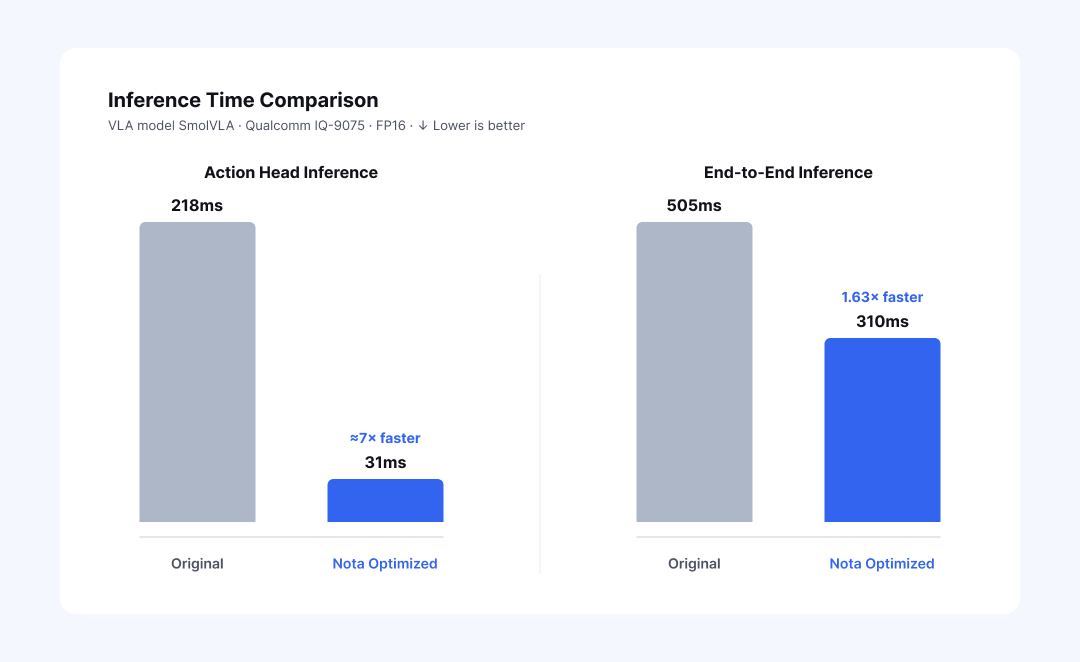
Figure 3: Original vs. Nota-optimized comparison of action head and end-to-end inference (Qualcomm IQ-9075, FP16)
This reduction in inference time translates directly into field productivity, because it means the AI spends that much less time "deciding its next move." In a single action it may look like a negligible difference, but on a mass-production floor where the same task repeats around the clock, like the humanoid parcel sorting seen earlier, the story changes. Whether these tiny delays pile up or are cleared away translates directly into a gap in total daily throughput.
This technical flexibility of Nota AI is borne out by real deployment projects carried out across a wide range of target hardware. In fact, beyond Qualcomm, Nota AI has supplied AI optimization technology for Samsung Electronics' next-generation mobile AP, the "Exynos 2600," and holds a track record of building the inference-performance optimization platform for FuriosaAI's second-generation neural processing unit (NPU), "RNGD." From mobile and automotive APs to robot control boards, securing optimal execution performance tailored to the compute architecture and constraints of each different edge hardware is Nota AI's core competitive advantage.
Conclusion: In the Physical AI Era, Competition Shifts to 'Deployment'
"Nota AI has applied AI to real-world settings faster than anyone. In the AI era, competitiveness ultimately lies in proving customer value on the floor, satisfying performance and cost at the same time, and in continuously expanding on that. Nota AI is a company that has consistently put this into practice.”
Tae-Ho Kim, CTO of Nota AI (remarks as a panelist)
The axis of competition in the AI industry is already shifting. The question of "who builds the bigger, smarter model" is changing into "who can run that model to the very end on a real floor where both power and memory are tight."
As Physical AI proliferates, this challenge will only grow heavier. With every additional robot on a factory floor or camera in a city, the bottleneck of cramming a heavy model into a small footprint grows along with it. No matter how excellent an AI model is, if it cannot run in real time on the chip in the field, it will end up confined to a well-produced demo video. This, too, is why NVIDIA invited Nota AI as a key panelist at its APAC Partner Day.
Projects stalled at the limits of the cloud; the long-standing industry hesitation to adopt heavy models in the field. With optimization technology that bridges that gap, Nota AI is putting together the "final piece" that lets Physical AI move beyond lab demos and take root in real-world industry.

Stay ahead with Nota AI on LinkedIn. From edge AI trends to the latest tech updates — subscribe to Edge Insights and be the first to know. 👉 Subscribe now